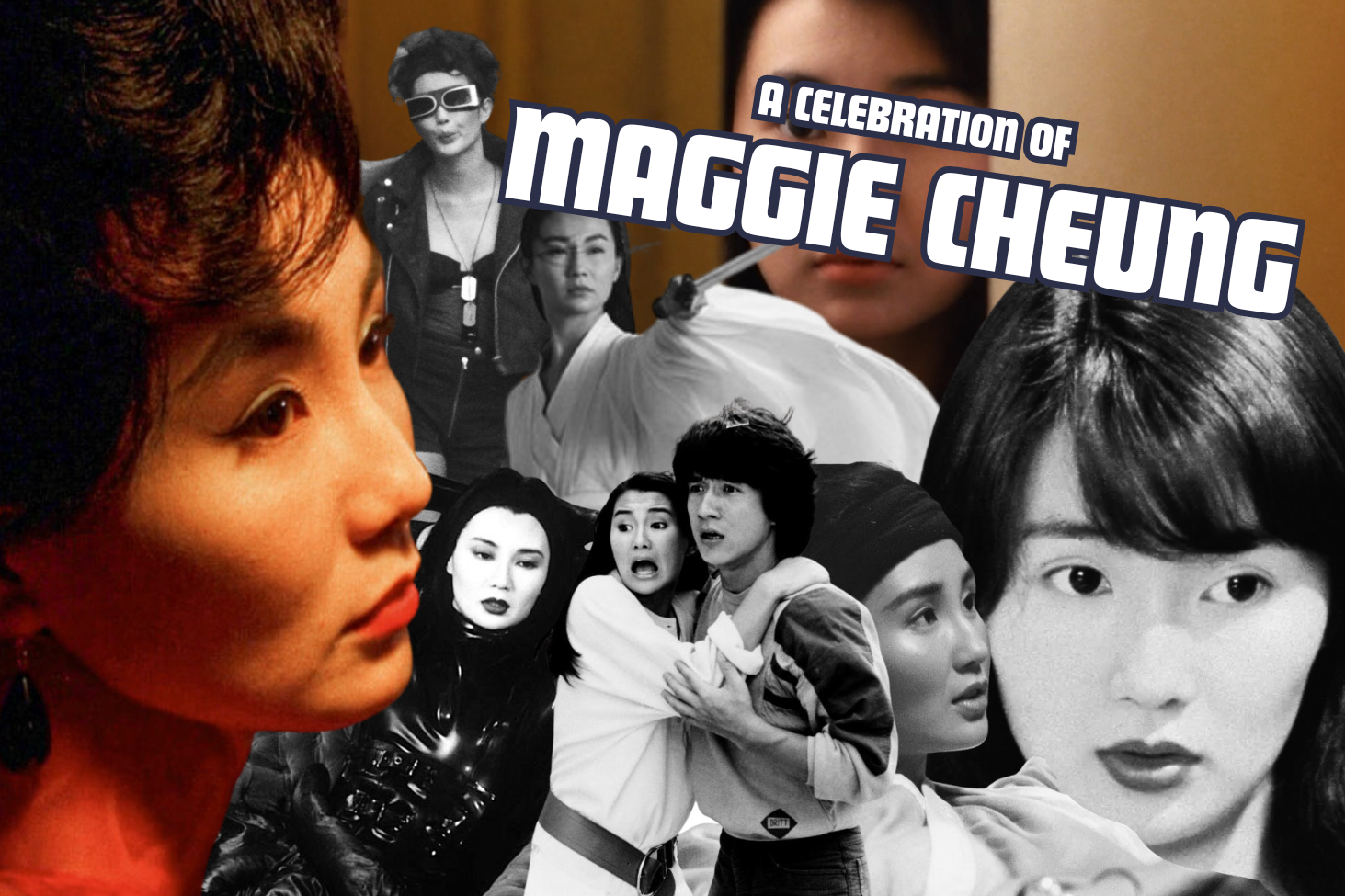

DISCLAIMER: As this is an American high school newspaper that’ll mostly be read by American high school students, that’s who this title is mostly directed at. Obviously anybody who’s remotely familiar with Asian cinema at all probably knows who Maggie Cheung is.
I think it’s safe to assume that most cinephiles have a “Mount Rushmore” of movie stars. Which is to say, four stars who are present in many of that cinephile’s favorite films. If I were to give my four right off the top of my head I would say Charlie Chaplin, Henry Fonda, Tom Cruise…and Maggie Cheung.
Yes, Hong Kong actress Maggie Cheung, who had her breakthrough in the early eighties only to continue to rise in stardom and talent as the decades went on. How does one movie star have such a wide variety of roles across cult classics, genre flicks, and all-time masterpieces? How did she go from being the pouty girlfriend in an action movie to being the lead of many? How did she go from giving one of the best performances of the ’90s to then also give what might still be the best performance of the 21st century, all before making an early departure from acting? We’re gonna find out.
So with that, let’s dive into the career of the beautiful and talented Maggie Cheung, a career that can be easily split up into three acts.
The first act of Maggie Cheung’s career probably contains the fewest “masterpieces,” but that doesn’t make it any less interesting. These are the films she appeared in that came out between the years of 1984 and 1992. Her first film appearance was in the little-known (and little-liked) sex comedy Prince Charming. However, her breakthrough hit was in Jackie Chan’s 1985 film Police Story. Police Story is about a Hong Kong cop (Jackie Chan) who’s deep in a case involving an evil crime boss. In the film, Cheung plays Chan’s girlfriend, May. Police Story has some of the greatest action sequences committed to film, but the role of May has little more to offer Cheung other than that of the girlfriend in an ’80s action movie. Yeah…she doesn’t get a lot to do. That’s why it’s all the more impressive when she pops like crazy in this thing. She has undeniable chemistry with Chan, and even though she’s removed from much of the action (Chan famously wouldn’t let women do fights on his sets until 1992 with Michelle Yeoh in Police Story 3: Supercop), she’s a key part of the final set piece, in which she does get to do a number of impressive semi-stunts. I know it’s a low bar to set, but I will give credit to Chan and his co-writer for portraying Cheung’s character as so much smarter than Chan’s. She’s not the most multi-dimensional character ever written, but it’s still a worthy breakthrough performance for Cheung.
Unfortunately, as seen with many female stars first discovered in the eighties, the industry started to fail Maggie Cheung. Between the years of 1985 and 1988, Cheung realized that she was being typecast. She was in a lot of movies, and the lead in some, but these roles weren’t what anybody would call amazing showcases for her as a movie star. So, in 1988, she did what every great movie star understands to do: she sought out new and exciting directorial talent.
When people talk about the great actor-director duos in cinema, they indubitably bring up Stewart and Hitchcock. De Niro and Scorsese. MacLachlan and Lynch. But I would argue that one duo that’s equally as important as all of those is Maggie Cheung and Wong Kar-Wai. Cheung is second-billed in Wong Kar-Wai’s debut film, As Tears Go By. Even though it’s his first film, it is undeniably a Wong joint. It’s got everything you might think of when somebody mentions Wong Kar-Wai: doomed romance, repressed feelings, nighttime sequences, step-printing, jukeboxes, etc. As Tears Go By follows Wah (Andy Lau), a gangster who’s trying to leave the life behind but keeps getting pulled back in by his idiotic brother (Jacky Cheung—no relation to Maggie). Meanwhile, his cousin, Ah-Ngor (Maggie Cheung) is staying with him, and they begin to fall for each other. As Tears Go By is an impressive debut from Wong, but it’s still a debut, which means that he’s still refining his craft. You can tell he’s playing with themes and filmmaking techniques that he would perfect later on. The same concept applies to Cheung’s performance. It’s a noticeable step-up from the roles she had been stuck in for the last couple of years, but her character’s frustratingly passive. Halfway into the film, though, when Wah and Ah-Ngor finally ignore the barriers between the two of them and start making out in a telephone booth (comically set to ‘Take My Breath Away’ by Berlin), it’s disarmingly sexy, and it’s a scene that wouldn’t work without the performances given in the first half, but more on repressed feelings of love later on…
The same year as As Tears Go By, Cheung reprised her role as May in Police Story 2. May takes a more central role in Police Story 2 and even performed a deceptively dangerous stunt that actually injured her—as seen during the end-credits. On the other end of the acting spectrum, her next collaboration with Wong Kar-Wai came in his second film, 1990’s Days of Being Wild. Days of Being Wild is a much more cynical film than most others in Wong’s career. Once again, Cheung is sort of stuck in the girlfriend role, but still…this is probably her best performance up until this point. She plays right into the vibes that Wong is going for in this one. When she’s left early on by this film’s “protagonist,” Yuddy (Leslie Cheung—again, no relation), she plays heartbroken in the most Wong-way possible. That is to say, extremely effectively. However, in both Days of Being Wild as well as in Police Story 2, you can feel Cheung is getting sick of the semi-thankless girlfriend roles. In Police Story 3: Supercop, her role is minimal and almost entirely comedic (except for when she’s kidnapped yet again). You can feel her wanting to break free from this type of role.
And so, the same year as 1992’s Supercop, Cheung starred in the martial arts action-flick Dragon Inn (or New Dragon Gate Inn, depending on where you are in the world), a remake of the 1967 classic. This is the beginning of the second act of Cheung’s career, which spans the years 1993-1996. Dragon Inn is set during the Ming Dynasty and centers around the rescuing of two children (two human-macguffins whom the movie understands are better utilized when they aren’t getting in the way of the action) from a ruthless official. In an attempt to get across the border, the rescuers come to the titular inn, where they encounter Gam Seung Yuk (Cheung), the horny inn owner who just wants to get hitched. Or acquire more money. Ideally both. This isn’t the most well-written role Cheung has ever played, but up until this point, it could certainly be the most meaty. She prances around every scene as if she’s a sexy Bond girl who’s one step ahead of good ol’ James. The actual movie ends up being somewhat forgettable (it falls apart almost entirely in the last ten minutes), even with her charismatic energy. That’s why it’s such a relief that, in 1993, she would refine aspects of this role in The Heroic Trio, in which she starred alongside contemporaries Michelle Yeoh and Anita Mui. Cheung plays “Thief Catcher,” a vigilante who’s too good for the police force. Not to be hyperbolic, but this performance is a revelation. Thief Catcher enters on a flying motorcycle, crashing onto the scene of an in-progress hostage situation. As we get our first close-up of her, Cheung breathes a sigh of relief—finally she gets to be the action star. She’s at the center. The Heroic Trio is one of the goofier blockbusters ever made, but Cheung understands the assignment completely and gets the most mileage out of the script just because she’s so darn captivating. It goes without saying that The Heroic Trio was a huge hit in China (spawning a slightly more mediocre sequel, Executioners, just one year later) but it didn’t go without international attention. One of the people who saw it was French director Olivier Assayas…
One year later, Cheung reteamed with Wong Kar-Wai in his Samurai-saga Ashes of Time, but after that, she took a two-year hiatus from acting. With this break, Cheung considered what was truly important to her and what kind of roles she wanted to pursue from this point on. That became extremely apparent when, in 1996, her next film was released and the third (and final) act of her career began. These are the films from 1996-2004.
As mentioned, French director Olivier Assayas saw Maggie Cheung as Thief Catcher months before he actually met her at the 1994 Venice Film Festival while she was promoting Ashes of Time and he immediately fell in love (literally too, they were married in 1998). And so, with Cheung as his inspiration, Olivier Assayas began developing Irma Vep.
Irma Vep is an incredibly strange film. It begins with an enticing minute-and-a-half-long shot drifting through a French film production office, taking us through all the jobs, with people having heated negotiations over the phone as a man recites his resume at the beginning of an audition. The shot ends just after Cheung makes her entrance, which makes sense, as she’s visibly out of place in this environment. Cheung plays…Maggie Cheung, a slightly fictionalized version of herself who’s come to France to star in a remake of a film called Les Vampires, a black-and-white silent film about a spy/burglar dressed up in tight, latex suit (the tagline for Irma Vep is “A Latex Comedy”). The director of the remake, René (French icon Jean-Pierre Léaud of The 400 Blows) is an obvious stand-in for Assayas, which becomes apparent when—in René and Cheung’s first scene together—they literally watch a scene from The Heroic Trio and René tells Cheung, “This is why. This is the reason. Do you understand what I say?” A moment later, he responds, “You are like a dancer. And also like an acrobat. You know…and this scene is very, very beautiful, like floating in the air.”
Irma Vep is very much in conflict with the pretentious nature of contemporary French cinema that Assayas had perceived, and here he is presenting a character who isn’t affected by that. She responds to his compliment by saying, “Thank you, but really they were just done by stunts.” René doesn’t seem to care about her negativeness towards the goofiness of the film, though (whether that actually reflects an attitude possessed by Cheung at the time is up for debate), he just wants to cast her because he thinks he can make something beautiful with her. He’s not deterred by how some of his peers scoff at the fact that he’s hired a Hong Kong action star to be in a remake of an esteemed French classic, but at the end of the day, René fails. Cheung is dropped from the movie and he goes insane. Listen, the “plot” of Irma Vep is almost extremely irrelevant here and probably sounds like absolute nonsense on paper, but what we’re here to talk about is Maggie Cheung. So how does she handle playing “herself”? Well, the answer is better than maybe any actor who’s ever tried to do it. Irma Vep is a culmination of every performance she’s given up until this point, and that’s not just because of the references to Police Story and The Heroic Trio. Cheung plays the scenes of personal drama just as well as she does the goofy scenes in the fake movie she’s starring in. Not that there wasn’t an impressive variety in her previous performances, but up until this point, Cheung basically had two main personas, and Irma Vep beautifully utilizes both of them. However, it’s not all variations of things she’s done before. When her character begins to slip slightly into madness (possibly…it’s intentionally unclear) just as the director René had, Cheung plays it in such an odd way that no other actor would think to do, and it’s genuinely astonishing to watch. Just as always, Cheung perfectly understood the assignment the film was giving her.
Irma Vep was critically respected at the time and has only gained respect and affection since its release in 1996 (the Criterion Blu-ray is beautiful). In 2022, Olivier Assayas, twenty-one years after his divorce from Cheung, helmed a remake of Irma Vep in the form of an HBO tv series, but that’s an essay for another day…
So what did Cheung do after starring in what seemed to be a culmination of everything she’d done up until that point? That same year, she starred in Comrades: Almost a Love Story (a well-regarded little movie), and she had a few films come out between over the course of the next four years, including a reteam with Michelle Yeoh in a historical drama titled, “The Soong Sisters,” but she was clearly slowing down. She was no longer starring in ten movies a year like she had been in the first half of her career (a luxury of being a movie star; you don’t have to be in as many movies). And then came the turn of the century, and Cheung appeared in her most important film to date.
Cheung gets top billing in Wong Kar-Wai’s 2000 film In The Mood For Love, followed by the great Tony Leung. That’s right, in their fourth collaboration together, Cheung finally is the lead of a Wong picture. After the beautifully simplistic opening credits roll though, the background changes from red to black as these words are displayed: “It is a restless moment. She has kept her head lowered, to give him a chance to come closer. But he could not, for lack of courage. She turns and walks away.” This film makes a million daring choices, but describing the whole movie so bluntly in the opening quote has got to be one of the most. Sure enough, after that quote, the film introduces us to Su Li-Zhen (Cheung) and Chow Mo-wan (Tony Leung), two married people moving into the same apartment building in Hong Kong, 1962. They bump into each other once or twice and the chemistry between them is potent, but what eventually brings the two characters together is their suspicion that their spouses are cheating with each other on them. Let me be clear, I consider Wong Kar-Wai’s 2000 film In The Mood For Love one of the greatest films ever made, so I won’t drone on about Wong’s break from his usual style, the choice to never show the spouse’s faces on camera, the tragic ending and the theory that a lot of people have about it, no, for now I’d just like to talk about one shot in particular. That shot hits at 37 minutes and 16 seconds into the little-less-than 100-minute movie…
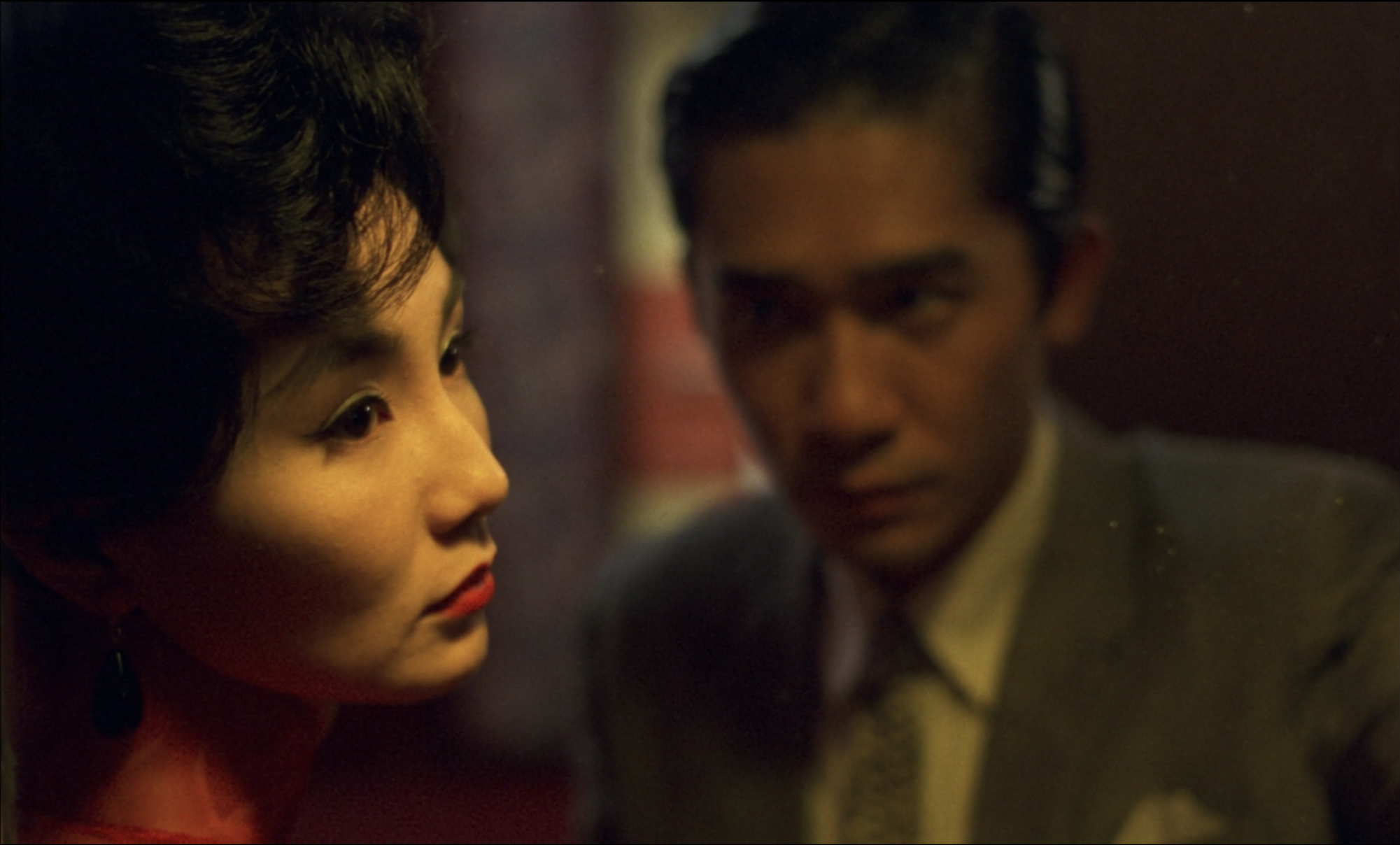
In the shot, Cheung is looking up at something as Leung watches her longingly. She then looks back at him for a split second, then turns and walks away, leaving him staring at the ground as the camera rack-focuses on him. I know it must sound pretty underwhelming as I’m describing it, but it might be…my favorite shot ever? And most of it is just a close-up of Cheung’s face (a testament to her power as an actor). It’s an entirely beautiful thing when a movie can fully encapsulate everything about it thematically in one shot, and Wong pulls it off with this one. He wouldn’t have been able to though, without Cheung. I’ve watched this shot a million times, and it’s taken me a little less time to recognize the complicated simplicity that Cheung manages to pull off in this shot. She seemingly doesn’t do a lot, but every twitch of the face, every small movement, is so well calculated, and when Leung finally shifts to being the focus, you realize she has him in the palm of her hand. One could easily read this as a crucial turning point in the film. The point at which he really falls in love with her. It goes without saying that Leung wouldn’t be able to play that so easily without her performance.
I know I’ve talked a lot about that one shot, but I did so because it’s indicative of her performance throughout the whole movie. Everything about it is so well-calculatedly reserved, but much like in her first collaboration with Wong, all that contained emotion eventually reaches its boiling point. Yet, here it’s not a burst of lust, it’s one of sadness. When Su’s suspicion that her husband has a mistress is confirmed, she cries in Leung’s arms as he devastatedly holds her. These two performances, coupled with a brilliant editing choice made by Wong and his collaborators (the only time the film uses Wong’s famous step-printing effect) make for an emotional experience.
Cheung would sort of reprise her role as Su in a brief (but effective) part in Wong Kar-Wai’s masterpiece follow-up to In the Mood for Love, 2046, but I’ll save talking about that movie for another essay…
Also in 2004, Cheung starred in her final leading role. She reteamed with Assayas to make a film called Clean, about a woman who just recently got out of prison for heroin possession and finds out she no longer has parental custody over her son, whose father died of an overdose. As much as I wanted to love Clean, I just don’t have that many thoughts on it. It’s a little dull and miserable! I’m not saying every movie has to adhere to rules of tonal levity, but the amount of times that the film almost became humorous because of how depressing is too great to ignore. However, there’s a scene towards the end when the film finally feels like it becomes what it probably should’ve been the whole time. It’s a scene shared between the two main characters of the film, Emily and her son’s grandfather, Albrecht (Nick Nolte), and the two actors have a really interesting chemistry that just isn’t utilized nearly enough in the rest of the film. Oh well. There was potential for greatness here, but ultimately Clean ends up being sort of a bummer to end Cheung’s filmography on.
Since her retirement from acting, Cheung has kept herself busy, dabbling in music, editing, and even growing her own food, expressing very little interest in returning to acting in major roles. I think it’s clear after all of this that I, for one, would love a new film starring the illustrious Maggie Cheung. She’s such a fascinating presence that I think has been lacking the last 20 years of cinema, but it’s important to remember in situations like these that Cheung doesn’t owe us anything. She gave us decades of unique and incredible career choices and beautiful performances (I didn’t even talk about Hero)!
Cheung remains, and will remain, one of the greatest movie stars of all time, and if her current filmography is all the cinema world gets from Maggie Cheung—I’m not complaining one bit.