








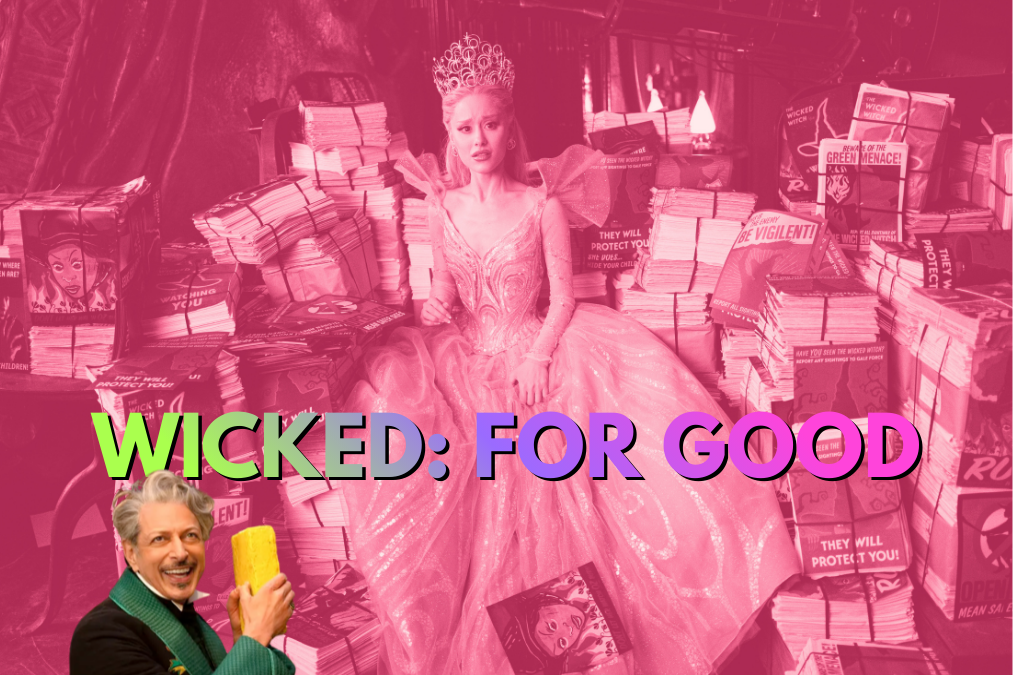
Say what you will about the first Wicked (I think I’ve made my opinions clear in the past), but there’s little denying that director Jon M. Chu was able to translate the first act of the iconic Broadway show from the stage to the screen in a way that made it feel like its own thing. It’s only a little bit of a jump to go a step further and say that, for all its fanservice, one could potentially watch Wicked (Part One) without any prior knowledge of the Broadway show (or the original Wizard of Oz, for that matter). Those two things, unfortunately, cannot be said for Wicked: For Good.
“Maybe ‘hate’ is too strong a word. I didn’t hate Wicked,” is what I said in my piece from last year, comparing Part One and the (endearing) nightmare that is Walter Murch’s Return to Oz from 1985. Despite this (what I found to be) less-than-hyperbolic stance about Part One, for the last year I’ve had to deal with all of my fellow theater-kid friends telling me that I was being too harsh. For obvious reasons, in the last couple of months, things have gotten worse. People told me to rewatch it, give it another chance. Many of my friends who have seen the second act (that is to say, onstage) have been convinced that I will enjoy For Good more than I did the first one. I was almost convinced. My friend Jillian Leman was one of those people and together we made a convoluted bet that if I liked the film she would get to pie me in the face and I would be required to write an article about how wrong I was, but if I didn’t like it then she would buy me two boxes of Sour Mike & Ikes. Suffice it to say, she owes me some Sour Mike & Ikes.
For those of you unfamiliar with the second act, Wicked: For Good starts five years after the last film ended. Elphaba (Cynthia Erivo) has now been dubbed the ‘Wicked Witch of the West,’ and is continuing her protesting for the animals and against the Wizard (Jeff Goldblum, who’s phoning it in, but sometimes watching Goldblum phone it in can be fun), while Glinda (Ariana Grande) continues working for him and Madame Morrible (Michelle Yeoh, who’s slightly less fun to watch phone it in) as their spokesperson of sorts.
About halfway through Wicked: For Good’s 138-minute runtime, I came to the conclusion that I shouldn’t try to think about Wicked as a prequel to the original Wizard of Oz whatsoever. This is a takeaway I’m not sure was ever fully decided on in the development process for these two films. For those of you who don’t know, The Wizard of Oz takes place concurrently with the second act of Wicked, and although I haven’t seen the show live, Chu’s new film deals with this by never showing us Dorothy’s face. When I say the film wants to have its cake and eat it too, I mean it wants to give the audience a nostalgic boost, but doesn’t want to deal with the greater implications that it’s inadvertently setting up. Dorothy’s always filmed from behind, in shadow, or—confusingly— in one shot: we’re in her POV. The decision to never show us Dorothy in full isn’t necessarily a bad idea, and it’s better than having some nightmare CGI version of Judy Garland show up, but it winds up confusing the audience as to how much we should be thinking about this as the same universe as the 1939 classic. This confusion isn’t helped by a few of the twists and transformations that occur in For Good. The first Wicked had its fair share of references, but it shocked me tremendously to find out how much the second half feels like online fanfiction. None of this would be an issue (okay, maybe some of it would still be an issue) if the original musical’s second half made much of an effort to make the two coinciding stories make sense alongside each other, but alas—this is not the case. Chu is so faithful in his adaptation to the show that he and his cowriters refused to make the necessary changes to the source material that might have a chance at making For Good feel like anything more than something you might read in a middle schooler’s spiral notebook. Perhaps, if Chu had chosen to cast a new Dorothy (thereby solidifying in our minds earlier on that this a retelling and not a traditional prequel), things would be different, but because there’s the implication that For Good could be watched back-to-back with the original Wizard of Oz, I kept asking myself questions like, “So, why does Glinda tell Dorothy that Nessa (Marissa Bode) was the Wicked Witch of the East? Is she that naive or a pathological liar?” “When did Elphaba start caring so much about those shoes? So much so that she’s willing to kidnap and torture a little girl?” “Why, if a certain character is the Scarecrow (I won’t spoil who), does he go on the whole journey with Dorothy? Did he plan it all out? Or does he not remember? Does that mean that he and Dorothy’s friendship (one of the sweetest parts of the original film) was all a lie? Does the same thing apply to the Tin Man?” “Why are Dorothy’s three friends all lying to her about never having any previous relationship to the Witch?” “Because they added that extra song called There’s ‘No Place Like Home,’ does this imply that Glinda’s plagiarizing Elphaba when she tells Dorothy to say that at the end?” (I have more, but I won’t get into those here because this is technically a spoiler-free review.) I know it seems like I’m nitpicking, but by not recasting Dorothy and dressing her faceless character up exactly like Judy Garland is in the original film, For Good invites this kind of frustrating speculation.
“But Ben, who cares about all this plot nonsense? What about the musical sequences?” you might be asking right now, and I don’t blame you. Isn’t that what this is all about? Some of the best musicals have unspectacular or even paint-by-numbers plot points, but when monkey-Robbie Williams starts dancing down the street to Rock DJ while hundreds of extras dance with him, who gives a flying fart about the plot? In my article about the first Wicked, I complained about what I found to be lifeless musical numbers (with the exception of ‘Dancing Through Life’) in contrast with some of Chu’s previous work such as 2021’s In The Heights; he seemed at a loss for how to stage the emotional ballads other than to literalize them. For Good suffers from those same issues ten-fold. The second act of Wicked already has less choreography-oriented numbers (where Chu’s talents as a director tend to shine), so the musical numbers are even more lifeless than Part One. “Ben. Wait. What about the titular song, Ben? What about ‘For Good’?” you might be asking. I’m sorry to say that I can’t recall a single shot from that entire scene. There’s no take in the blocking or camera movement other than “Have the camera move around them while they sing about how much they love each other!” The cinematic storytelling should elevate the story. Because the lackadaisical filmmaking clashes with the grandiosity of what’s happening in the scene and the song, it prohibits my ability to buy it as a crucial moment in the film. I don’t believe it.
Wicked: For Good isn’t just boring, it’s sweaty. The plot gymnastics necessary to get the characters to the point that they’re at at the end of the musical does a disservice to those characters as well as the audience. That specific disservice is something I wouldn’t have predicted. I know it sounds like I’m a ranting, Negative Nelly who never wanted to like the movie, but I promise that’s just not true. Okay, well, maybe the ‘ranting’ part is, but the latter is most certainly not. I sat down wanting to like Wicked: For Good. I was seeing it with a friend, in a theater, before the film was even technically out, with no critical reactions to taint my thoughts about it. I was meeting the movie on its turf. I wanted to like it. Because all my friends love it! Watching For Good though, I really started to wonder if they actually do. Art is subjective, but watching both Wicked movies, I get the sense that this is perhaps a case of people telling themselves they like something more than they actually do. If the film wasn’t about Elphaba and Glinda, would they go as nuts for it? I don’t think so.
The same day I watched Wicked: For Good, I finally got around to watching KPop Demon Hunters with a kid I was babysitting and was struck with how much I fell for it. It’s not the best movie ever (it’s not even one of the best of the year), but watching it I immediately understood the love for it among my friends and every single living elementary school kid (the child I was babysitting sang along to every song, which was cute). It’s the type of runaway success I’d like to see happen more often in the movie industry: a (technically) original film that’s not a movie based on a Broadway show, based on a book, based on a movie, based on a book–a movie that wins people over based on its own merit and not brand recognition. I hope the success of KPop Demon Hunters convinces Netflix and other studios to take bigger chances on fewer cookie-cutter ideas based on recognizable IP because it’s these movies that truly make an impact and leave the audience feeling fulfilled. I also hope that that film, along with the success of the Wicked movies, convinces those same studios to make more musicals…just preferably not more musicals that cost over 300 million dollars and feature a nightmarish, scarecrow version of Jonathan Bailey.
Oops. Did I say too much?

