











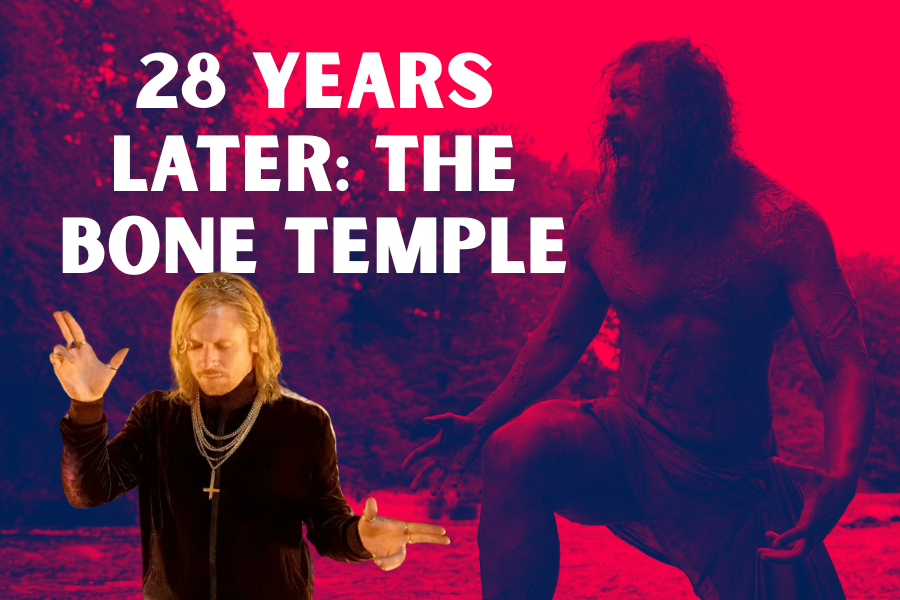
I swear I’m not kidding when I say that there are significant portions of Nia DaCosta’s 28 Years Later: The Bone Temple that play like a rom-com. At the beginning of the film, we’re reintroduced to Doctor Ian Kelson (a sublime Ralph Fiennes). First introduced to us in the last movie (which came out just seven months ago), here, he’s beginning to experiment with one of the Infected, Samson (Chi Lewis-Parry). When I say “experiment,” I mostly mean he gives Samson a daily dose of morphine, which seems to chill him out. Dr. Kelson soon realizes that Samson is craving these doses and they become buddies.
The Infected (psuedo-zombies) are essentially the hook of the 28 franchise, but they seem to be least of The Bone Temple’s interests. Thematically, this installment feels like a further exploration of the themes from the iconic third act of Boyle and Garland’s movie from 2002. In that act, man is the villain. Not the zombies (as is the takeaway from most good zombie movies). However, 28 Days Later does not have a sequence in which somebody gets high with one of the Infected and dances with them to Duran Duran. Which is exactly what Dr. Kelson does with Samson. This got a good laugh out of me, but I soon found myself getting emotional over how beautiful this relationship is. After 28 years, Dr. Kelson’s fully embraced the idea that fighting rage with rage is counterproductive.
Fear not, horror fans! It’s not all dancing and friendship! In fact, The Bone Temple has some of the more upsetting scenes I’ve witnessed in recent memory. In the first scene of the film (presumably only a few minutes after the end of the last one), Spike (Alfie Williams) is made by Satanist Jimmy Crystal (Jack O’Connell, who, based on his last few films, is not to be trusted) to either kill one of his followers—who all also go by the name Jimmy—or die himself. This is not Paul Atreides defeating Feyd Rautha in Dune: Part Two. Which is to say, it’s not cool or triumphant—it’s upsetting. Spike ends up “succeeding” by stabbing this Jimmy (Connor Newall) in the leg, where he unintentionally hits an artery. Spike is then forced to watch his opponent bleed out on the ground before Jimmy Crystal names Spike ‘Jimmy’ and makes him one of their own. This is far from the most distressing thing the Jimmys do in this film.
Director Nia DaCosta doesn’t shy away from visually representing Dr. Kelson’s and Jimmy’s scenes entirely different from one another. Dr. Kelson’s scenes with Samson are, indeed, shot like a rom-com, while Jimmy Crystal’s like the horror scenes that they are. It’s a strong directorial showcase for DaCosta and makes one hope that this isn’t her last collaboration with writer Alex Garland, for both of their attributes seem to compliment each other.
Despite The Bone Temple’s cruel and high-minded nature, it never feels pretentious. This is, in part, because the major set piece has nothing to do with the Infected and is essentially a musical number (I won’t spoil how or why), but it’s also because of the solutions the film poses for how to live and adapt in a world gone mad. In today’s political landscape, the last thing Garland and his collaborators were interested in was the characters prevailing through violence. No, Dr. Kelson chooses love as his medicine for this disease. What could be less pretentious than that?
The Bone Temple isn’t a perfect movie (it’s just a little too serialized in its approach to being a sequel to really feel monumental), but I don’t doubt that it will soon become a classic much like its predecessors. I also don’t doubt that if Boyle and Garland get to complete this sequel trilogy, they’re going to do it in a bonkers fashion that has audiences cheering. In the meantime though, maybe we should take Dr. Kelson’s advice, pump up the Duran Duran, and choose love. Not rage.

