










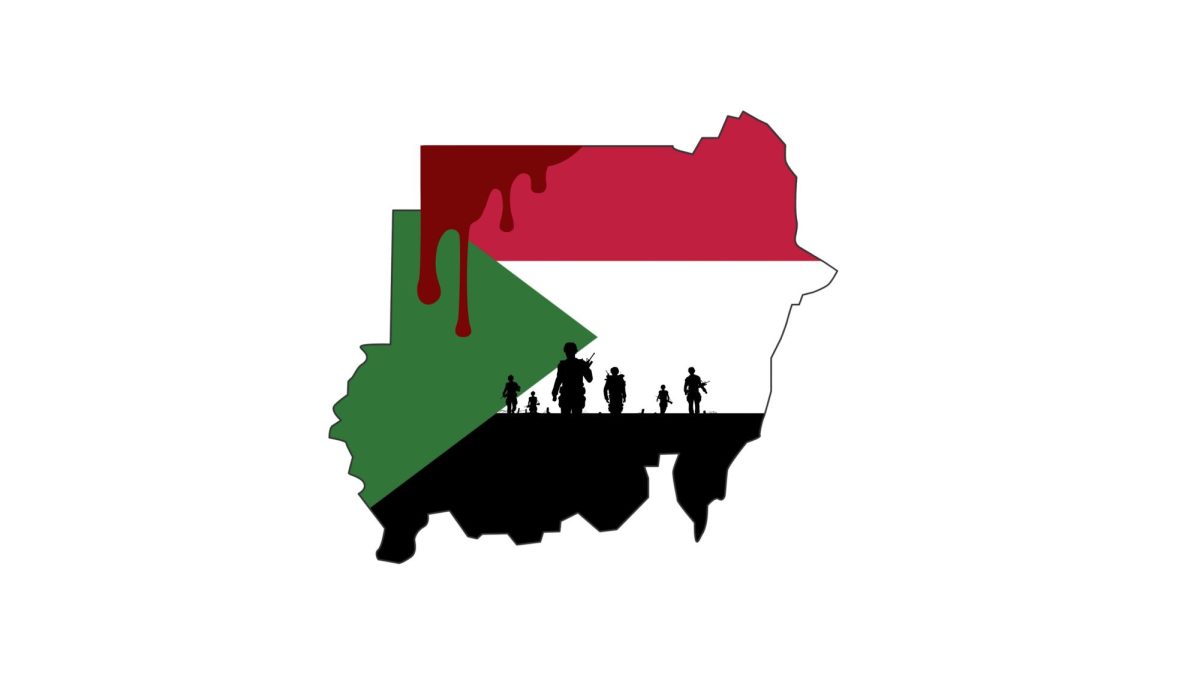
Nearly two years after the promised transition, Sudan remains plagued by broken promises of democracy. A nation cannot thrive when its leaders confuse authority with legitimacy.
Sudan has been facing this broken government branch since 1956. We like to think that when faced with a genocide, the world will unite and say, “Never again.” But right now in Sudan, that promise is being broken in real time, and the silence from global leaders is blaring. This isn’t another faraway conflict you see in a newsbreak; it’s “The World’s Largest Humanitarian Crisis” unfolding on a scale we haven’t seen in decades, and we need to pay attention.
The situation can be described in a fairly simple way: an all-out war between two brutal military groups, the Sudanese Armed Forces (SAF) and the Rapid Support Forces (RSF), has unleashed brutality on the Sudanese people. This is a campaign that is deliberately promoting systematic violence and ethnic cleansing, particularly in the region of Darfur; it is echoing a genocide that happened just twenty years ago. The U.S. government has officially called it what it is: genocide.
So what does that look like in practice? It’s not just a battle between soldiers. It’s targeted killings, entire neighbourhoods demolished and erased, and horrific sexual violence that is being used as a weapon of war against young girls and women. Over 12 million people have been forced out of their homes, making it the world’s largest displacement crisis. And to make things even worse, both sides continue to block essential food aid, pushing half of the population to the brink of starvation. Famine is a present reality in multiple areas, not a threat.
The international response has been a disgrace. While people are being starved and slaughtered, world leaders are moving with frustrating slowness. Humanitarian aid is desperately needed, but the fundraising targets are consistently missed. It’s frustrating that in an age of instant global communication, this crisis remains largely “forgotten.”
As Sudan’s civil war rages on, not only are the people being affected, but the war is erasing Sudan’s cultural memory. Historic archives in Khartoum have been burned, museums have been looted, and cultural landmarks have been destroyed. According to The Art Newspaper, Sudan’s National Museum is home to more than 100,000 artefacts and boasts the most comprehensive Nubian collection in the world. This is the history of Sudan; this is what Sudan should be known for. These ancient relics are being destroyed as the fighting continues to cover Khartoum and other major cities. For many Sudanese, the loss is beyond home and safety; it’s the loss of history itself. What began as a power struggle between the militaries has evolved into a conflict that is erasing Sudan’s history, memory, and future.
Nations around the world are exploiting the war in Sudan for their own gain. Sudan’s large gold reserves and its strategic location on the Red Sea are assets that many countries have been eyeing. According to the Financial Times, countries like the United Arab Emirates have contributed to the war effort by providing weapons and financial support to the RSF.
Right now, the UAE is supplying weapons to encourage the RSF to kill their own people. Many innocent civilians in Al-Fashir at the moment are suffering from starvation and are being slaughtered by their own people (RSF). RSF has committed many horrifying crimes against these innocent civilians. People in Al-Fashir are being hanged, buried alive, and even abused. More than 2,000 unarmed civilians have died just this past weekend. And the world is only watching this happen with no action. This bloody genocide has led to more than 150,000 people murdered and more than 14 million displaced Sudanese. Currently, more than 1 million Sudanese have fled Al-Fashir. Yet 260,000 civilians, half of them children, remain trapped without aid, and many have even resorted to eating animal fodder.
While we may feel powerless globally, we do have a responsibility. The situation in Sudan needs attention and action from the global community. Awareness is one of the few tools we have. Speaking about Sudan, sharing verified information, and supporting humanitarian organisations are actions that can make a huge difference. The people of Sudan cannot wait for the world to act at its own pace. Genocide is a word that should force the world to stop and act. The global community is failing Sudan, and that failure is a moral stain on all of us. “Never again” demands action, not just empty words. It’s time we raise our voices and force the world to finally listen.


Osman Ahmed • Nov 18, 2025 at 2:38 pm
Such an informative article by these young ladies!! So proud of you guys! Keep going.